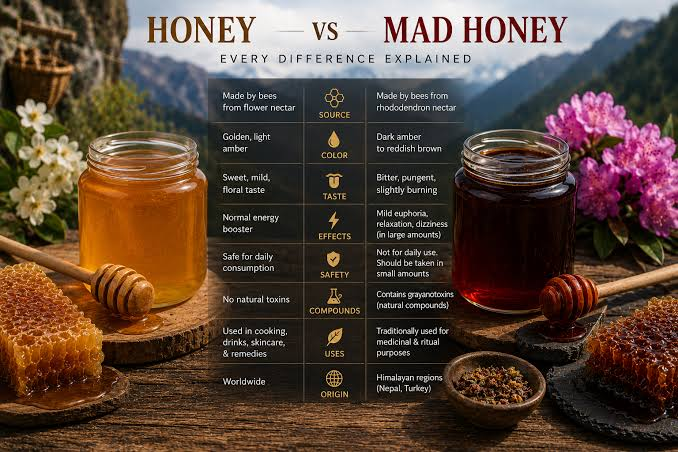

Honey may look like a simple natural sweetener, but its characteristics can vary significantly depending on the flowers visited by bees. Real mad honey stands apart from regular honey because of its botanical source, distinctive flavor, and naturally occurring compounds.
Regular honey is produced from nectar collected from a wide variety of flowering plants, while mad honey is traditionally associated with nectar from certain rhododendron species. This difference in floral origin gives mad honey unique characteristics and also introduces important safety considerations that consumers should understand.
The source makes the difference.
What Is Regular Honey?
Regular honey is a natural food produced by honeybees after they collect nectar from flowers. Bees process the nectar, reduce its water content, and store it in honeycombs, where it eventually develops into the familiar sweet substance consumed around the world.
The flavor, color, aroma, and texture of regular honey can vary depending on its floral source. Clover, acacia, wildflower, orange blossom, and other varieties each have their own characteristics.
Most regular honey is primarily valued as a food and sweetener. It can be used in beverages, baking, cooking, sauces, and a wide range of everyday recipes.
Its versatility makes it a kitchen staple.
What Makes Real Mad Honey Different?
Mad honey is a specialized type of honey traditionally produced in areas where bees have access to certain rhododendron flowers. These plants can contain naturally occurring compounds called grayanotoxins, which may pass into the honey when bees collect nectar from the flowers.
This botanical connection is the main reason mad honey differs from ordinary varieties. Its appearance can vary, but it is often associated with a darker or more distinctive color and a strong, sometimes bitter or earthy flavor.
Unlike regular honey, mad honey can have physiological effects because of the compounds derived from its floral source.
That difference deserves careful attention.
Comparing Their Floral Origins
The floral source is one of the clearest distinctions between the two types of honey. Regular honey can come from countless flowering plants, and many commercial varieties are produced from nectar gathered across diverse floral landscapes.
Mad honey, by contrast, is particularly associated with rhododendron species containing grayanotoxins. It is traditionally found in regions such as parts of Turkey and Nepal, where suitable rhododendron plants grow naturally.
The surrounding environment therefore has a major influence on mad honey production. Weather, plant species, geography, and seasonal flowering patterns can all affect the characteristics of individual harvests.
Nature determines the profile.
Differences in Taste and Appearance
Regular honey generally has a sweet flavor, although the intensity and complexity can differ between varieties. Some types are mild and delicate, while others have rich floral, fruity, or caramel-like notes.
Mad honey is often described as having a stronger and more unusual taste. Depending on the source, it may have earthy, bitter, sharp, or slightly medicinal notes that make it noticeably different from conventional honey.
Appearance alone, however, is not a reliable way to determine whether honey is genuinely mad honey. Color can change naturally according to floral source, processing, age, and storage conditions.
Taste tells only part of the story.
Understanding Grayanotoxins
The most important distinction between mad honey and regular honey is the potential presence of grayanotoxins. These naturally occurring compounds are found in certain rhododendron plants and can affect the nervous and cardiovascular systems when consumed in sufficient amounts.
Honey containing significant concentrations of grayanotoxins can cause what is commonly known as mad honey poisoning. Symptoms may include dizziness, nausea, vomiting, sweating, weakness, blurred vision, low blood pressure, and abnormal or slowed heart rate.
The concentration can vary significantly between batches.
For this reason, mad honey should not be approached in the same way as ordinary table honey.
Traditional Uses and Cultural History
Both ordinary honey and mad honey have long histories of human use, but mad honey has a particularly distinctive cultural background. In regions where rhododendrons grow naturally, local communities have traditionally harvested and consumed it in small quantities.
Historical accounts have contributed to the unusual reputation of mad honey, and traditional practices remain an important part of its cultural identity. However, traditional use does not establish that mad honey is a safe or effective treatment for medical conditions.
Cultural history provides context, not medical proof.
Modern consumers should distinguish between traditional practices and scientifically established health benefits.
How Mad Honey Differs in Safety
Regular honey is generally consumed as a food, although it should not be given to infants under one year of age because of the risk of infant botulism. Mad honey presents additional concerns because of its potential grayanotoxin content.
The effects can depend on the concentration of toxins and the quantity consumed. Some people may experience symptoms after relatively small amounts, while the exact potency of a particular batch can be difficult for consumers to determine.
People taking medications that affect blood pressure or heart rate should be especially cautious, as should individuals with cardiovascular conditions.
Natural does not always mean risk-free.
If someone experiences significant dizziness, fainting, vomiting, unusually slow heart rate, or other concerning symptoms after consuming mad honey, they should seek prompt medical attention.
Differences in Availability and Sourcing
Regular honey is widely available through supermarkets, farmers’ markets, specialty stores, and food producers. Because it is a common food product, consumers have many options when comparing varieties and sources.
Authentic mad honey is considerably more specialized. It is typically associated with specific geographic regions and seasonal harvesting conditions, making sourcing particularly important.
Consumers interested in real mad honey should look for transparent information about its geographic origin, botanical source, harvesting practices, and product composition. Vague descriptions or exaggerated health claims should be treated with caution.
Reliable sourcing matters.
Mad Honey as a Culinary Curiosity
For people interested in unusual foods, mad honey can be fascinating because of its regional identity and distinctive sensory characteristics. It represents an interesting example of how a plant’s natural chemistry can influence the properties of a food produced by bees.
Regular honey, meanwhile, remains a versatile ingredient suitable for everyday cooking and eating. Its broad range of flavors makes it useful in everything from breakfast foods and desserts to marinades and beverages.
The two products serve different roles.
Mad honey’s uniqueness should not be confused with evidence that it provides superior nutritional or medical benefits.
Making an Informed Choice
When comparing mad honey with regular honey, consumers should first consider what they want from the product. If the goal is a dependable natural sweetener for everyday use, conventional honey is generally the straightforward choice.
If the interest is in regional foods, traditional harvesting, or unusual honey varieties, mad honey may be of cultural and culinary interest. However, its potential grayanotoxin content means that consumers should research the product carefully and understand the risks before consumption.
Price and marketing should not be the only considerations. Origin, transparency, quality, and safety information are equally important.
Conclusion
Real mad honey and regular honey may share the same basic bee-produced foundation, but their floral origins and chemical characteristics can make them very different products. Regular honey comes from numerous floral sources and is primarily enjoyed as a versatile natural sweetener, while mad honey is associated with certain rhododendron species and may contain grayanotoxins.